|
|
|
|
|
||
History of the Royal Collection:
|
|
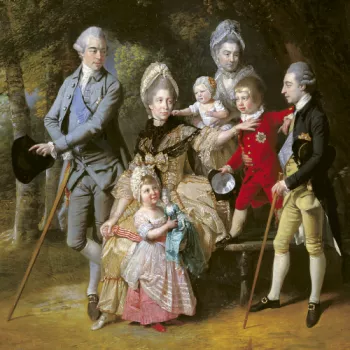
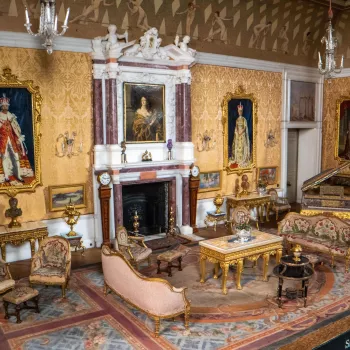
Charles I was described by Rubens as ‘the greatest amateur of paintings among the princes of the world’. During his reign the quantity and quality of his pictures, particularly after the acquisition of the Gonzaga collection from Mantua, established the high status of the Royal Collection and the British palaces alongside those of other European courts. The representation of works by Raphael, Leonardo da Vinci, Tintoretto, Titian and Correggio, as well as of contemporary painters such as Annibale Carracci (Allegory of Truth and Time, c.1584-5), Guido Reni and Orazio Gentileschi, and by sculptors such as Gianbologna was a highpoint in the history of the Collection. Some of the gaps in the Royal Collection created by dispersal during the Interregnum were filled by the arrival of 72 paintings bought by Charles II in the Netherlands, and by the handsome gift of pictures and sculpture from the States-General of Holland in 1660, which included a powerful portrait by Lorenzo Lotto (Andrea Odoni, 1527) and a painting now attributed to Giorgione (The Concert, c.1505). The king also managed to retrieve the important group of pictures, amongst which was Holbein’s ‘Noli me tangere’, that his mother, Queen Henrietta Maria, had taken to France in her widowhood. To all these were added in due course a considerable number of newly acquired contemporary works by Lely, Kneller and others, and a magnificent series of miniatures by Isaac Oliver. Charles II was aware of the significance of his father’s achievements as a collector. Yet the endeavours to restock the palaces with pictures after 1660, which resulted in Lucas Cranach the Elder’s Apollo and Diana, c.1530, Georges de La Tour’s St Jerome, c.1621-3 and The Massacre of the Innocents by Pieter Bruegel the Elder entering the Collection, could hardly equal Charles I’s magnificent purchases. Immediately following the Restoration, orders were placed for new regalia and for substantial quantities of new plate, both ecclesiastical and secular. This great influx of Baroque silver, much of it made by immigrants attracted to London by the prospect of lucrative commissions from the new court, remains at the heart of the present Royal Collection, for example the massive altar dish chased by Wolfgang Houser with the Last Supper. Charles II, who knew at first hand the style and grandeur of the court of his cousin Louis XIV, deliberately fostered the introduction of the French court style to England by frequently employing French craftsmen, many of them Huguenot refugees. Both before and after the Revocation of the Edict of Nantes in 1685, so much positive encouragement was given to Huguenots to settle in England that many areas of British life, especially the arts, were heavily colonised by French immigrant artists and artisans. William III (1650-1702) and Mary II (1662-1694) The ‘joint sovereigns’ William and Mary brought with them Huguenot artists who had fled in the first instance to Amsterdam. These artists may have included Gerrit Jensen, cabinet-maker to the Great Wardrobe from c.1680, and members of the Pelletier family. The latter were responsible for the introduction to the London cabinet-making and upholstery trade of the latest in Parisian design and technique, especially in the use of metal inlays and wood marquetry, of silver (table and mirror, 1699), and of sophisticated cutting and burnishing of gilded surfaces (candle-stands by Jean Pelletier, c.1701). In consequence, the finest furniture of this type was often virtually indistinguishable from pieces actually made in Paris. Queen Mary collected oriental porcelain (both Japanese and Chinese) and Delft earthenware flower vases and ornamental vases commissioned from the ‘Greek A’ manufactory of Adriaen Kocks. Queen Mary single-handedly invented a new form of massed display of porcelain, as an important element of the interior decoration of her apartments at Hampton Court and Kensington Palace. William III had a keen interest in barometers and clocks, bringing innovation in design, materials or technology to the Collection for example the siphon wheel barometer by Thomas Tompion, c.1700. Queen Caroline (1683-1737), Consort of George II (1683-1760) Queen Caroline’s intellectual interests included a deep passion for English history, particularly of the Tudor period. She probably instigated the purchase of the superb Holbein oil portrait of Sir Henry Guildford and commissioned a number of historical likenesses from the sculptor Michael Rysbrack. She also brought together a distinguished collection of cameos and intaglios, some part of which may have survived from the 16th-century royal collection and which, with later purchases, forms the nucleus of the present collection of gems and jewels (Cameo of Elizabeth I). Frederick Louis, Prince of Wales (1717-1751) Frederick, Prince of Wales formed a significant collection of French, Flemish and Italian paintings for his houses at Kew and Cliveden, and Leicester House in London. These included major works of the 17th century by Claude (A View of the Roman Campagna from Tivoli, 1644-5), Gaspar Poussin, Le Sueur, Jan Breughel the Elder, Rubens, Frans Hals (Portrait of a Man, c.1630), Van Dyck and Guido Reni. In the contemporary field he patronised rococo artists such as Mercier, Amigoni and Vanloo, very much at variance with the prevailing taste at his father’s court. Other acquisitions include an album of drawings by Poussin from the collections of Cardinal Massimi and Dr Richard Mead, and a superb group of miniatures by Isaac Oliver (including Portrait of the Artist, c.1590 and Portrait of a Young Man, c.1590-5) also from Dr Mead. The prince’s taste for the rococo found further expression in his adventurous patronage of goldsmiths such as Paul Crespin and Nicholas Sprimont (The Neptune Centrepiece), and of the frame-maker Paul Petit. His commissions for furniture indicate a more conventional taste for the restrained Palladianism of cabinet-makers and carvers in the Burlington-Kent circle, such as Benjamin Goodison and John Boson. George III (1738-1820) and Queen Charlotte (1744-1818)George III made the most significant additions to the Royal Collection since Charles I. In 1762, two months after purchasing one of the finest houses in London, Buckingham House, for his young bride Princess Charlotte of Mecklenburg , he acquired the celebrated collection of paintings and drawings, books, manuscripts, medals and gems formed by the British consul in Venice, Joseph Smith. This brought to the Royal Collection a superb series of modern Venetian paintings and drawings, including works by Canaletto (Venice: Piazza S .Marco with the Basilica and Campanile, c.1725, A capriccio with terrace and loggia, c.1760), Sebastiano (Two heads, c.1726) and Marco Ricci, Zuccarelli, Rosalba (A self-portrait in old age, c.1745) and Piazzetta (Two girls with a bird-cage and a youth with a gun, c.1720), earlier Italian works by Bellini, Strozzi and Guercino, drawings by Raphael, Castiglione (Moses receiving the Tablets of Law, c.1660) and others, and an important group of Northern pictures including the incomparable Lady at the virginals with a gentleman by Vermeer (then attributed to Frans van Mieris). Smith’s library, in which the bibliophile king was especially interested, contained an important group of incunabula and manuscripts, as well as fine gems, coins and medals. These were absorbed into George III’s steadily growing collection, which was regarded as one of the finest in Europe. In his pursuit of books George III was successfully filling the void left after George II’s donation of the old Royal Library (its contents dating back to the reign of Edward IV in the 15th century) to the British Museum in 1757. The king was given an important group of incunabula by the collector, Jacob Bryant (1715-1804). Other outstanding volumes in his library were the Mainz Psalter; the only existing perfect copy of Aesop’s Fables, printed by William Caxton in 1484; Charles I’s copy of the Second Folio of Shakespeare (1632), which includes annotations made by the King; and a unique and superbly illustrated seventeenth-century Islamic manuscript, the Padshahnama. Consul Smith’s gems (Cameo head of Zeus, 2nd/1st century BC, English pendant jewel, 16th century) added significantly to the existing collection, as did Smith’s coins and medals. The latter were included with books and manuscripts in the second royal gift to the British Museum, when George III’s library was handed over by George IV in 1823. George III’s patronage of contemporary artists such as Ramsay, West, Zoffany (The Tribuna of the Uffizi, c.1772-8), Gainsborough, Hoppner, Copley (The three youngest daughters of George III, 1785) and Beechey (Princess Augusta, c.1802) – but not Reynolds, whom the king and queen disliked – was predominantly geared to portraiture. From the most highly favoured of these, the American-born Benjamin West, the king also commissioned a series of history paintings, designed to illustrate virtues that he particularly admired such as honour, fortitude and chivalry. George III particularly disliked grandiose display, always preferring elegance, practicality and simplicity to ostentation. The decorative arts commissioned for Buckingham House demonstrate his concern to support British manufacturers and entrepreneurs. They included superb mahogany furniture by Vile and Cobb, Bradburn, and France and Beckwith (but not by Thomas Chippendale, who never achieved a royal warrant), silver by Heming, porcelain from Chelsea (The ‘Mecklenburg’ dinner and desert service, 1763), Derby, Wedgwood and Worcester, ornamental metalwork from Matthew Boulton (the mantel clock by Thomas Wright of 1770-1) and a pair of candle and perfume vases designed by Sir William Chambers. The king’s own expertise in horology was reflected in his patronage of clockmakers, such as Benjamin Vulliamy, Eardley Norton, Christopher Pinchbeck, Alexander Cumming (barograph, 1763-5). A different and lighter taste was enjoyed by the queen, influenced to some extent by her study and practice of botany. A liking for the Orient – lacquer, ivory (the suite of Indian ivory furniture, c.1770), jewelled objets de vertu (writing case) and painted furniture - was mingled with the tastes she had acquired in her native north German principality in the 1750s, including Sèvres and German porcelain. George IV, when Prince of Wales and Prince Regent, provided ample proof of having inherited his mother’s continental outlook, expressed in his love of fine jewellery and the acquisition of French and German porcelain and French furniture. His was an all-consuming passion for collecting and an obsessive concern with architecture and interior decoration. George IV’s additions to the collection at all levels and in all areas – pictures, furniture, porcelain, silver, weapons and ‘curiosities’– fundamentally and completely transformed the Royal Collection. He also commissioned very large quantities of personal jewellery, some of it of extraordinary splendour (Sash badge by Thomas Gray, 1787-8 and the Diamond Diadem by Rundell, Bridge & Rundell, 1820). George IV formed a small library at Carlton House, his lavish London residence up to the time of his accession in 1820. It included a considerable number of fine items, such as the Sobieski Book of Hours, a magnificent illuminated manuscript from 1420-5; the beautiful 17th-century Florilegium of Alexander Marshal, including his 159 watercolours; and several outstanding Islamic manuscripts, including the Divan-i-Khaqan written by Fath Ali Shah, ruler of Persia. George IV was not afraid to edit his collection in the interests of refining and improving. Thus, when he acquired 86 of Sir Thomas Baring’s superlative Dutch pictures en bloc in 1814, a number of lesser items (mainly still lifes) were sent for sale; and when negotiating in the same year for the Rubens Landscape with St George, the balance of the price was made up with four lesser pictures including two from the Baring purchase. Other more disinterested – if regrettable – disposals included the gift to Greenwich Hospital of Turner’s Battle of Trafalgar (1823), the only oil painting by this greatest of English artists to enter the Collection. George IV shared the taste of his contemporaries for pictures of painterly quality with a high degree of finish and strong narrative content often on a small scale (attributed to Louis Le Nain, The Young Cardplayers, c.1630-40; Gerard ter Borch, The Letter, c.1660-62). He purchased a number of masterpieces by Rembrandt, including the dazzling portrait of Agatha Bas and The Shipbuilder and his Wife, both among the finest works in the artist’s oeuvre; the latter was the most expensive painting purchased by the king. He also acquired outstanding pictures by Rubens (Milkmaids with cattle in a landscape: ‘The Farm at Laeken’, c.1617-18) and Teniers. The acquisition in 1814 of the Dutch pictures belonging to Sir Francis Baring brought the total of his Dutch and Flemish paintings to some 200, including examples of consummate quality by Aelbert Cuyp (The Passage Boat, c.1650), Gerrit Dou, Nicolaes Berchem, Philips Wouwermans and Adriaen van Ostade. Although George IV’s enthusiasm for French art – so notable in the decorative arts – is not so apparent in his acquisitions of paintings, some important purchases were made in the early 19th century (Elizabeth Vigée Le Brun Charles-Alexandre de Calonne, 1784). Religious art and still lifes played only a small part in George IV’s acquisitions of paintings, although the former category included such masterpieces as the Rembrandt Noli me tangere and the Rubens sketch of the Assumption of the Virgin. Dutch and Flemish pictures of superb quality were added in considerable numbers, and from the Italian School paintings by Canaletto and by Sebastiano and Marco Ricci. Works with a strong family connection were keenly sought, and he added the famous Van Dyck Charles I in three positions. George IV’s patronage of contemporary artists is well documented. He particularly favoured George Stubbs, commissioning a series of superb canvases (including William Anderson with two saddle horses, 1793), and Ben Marshall, Sawrey Gilpin and George Garrard. In portraiture, George IV had an unparalleled choice of artists, including Reynolds, Gainsborough, Beechey and, pre-eminently, Thomas Lawrence. As Van Dyck was to Charles I and his court, so Lawrence became to George IV, expressing in a great series of bravura portraits the character and style of this beguiling monarch and that of his family, friends and contemporaries. In the Waterloo Chamber at Windsor Castle, commissioned portraits of the Allied Sovereigns and military and political leaders celebrated the overthrow of Napoleon (Pope Pius VII, 1819). On a smaller and more intimate scale, the king chose genre painters such as David Wilkie, Edward Bird and William Mulready, their style and anecdotal subject matter blending well with the Dutch and Flemish cabinet pictures of the kind he had assembled in quantity. He was also a great supporter of Wilkie when the artist turned to history painting (The Defence of Saragossa, 1828). As in so many other fields, the collection of sculpture was greatly enriched by the acquisitions made by George IV between the 1780s and his death in 1830. His purchases included approximately seventy eighteenth-century French bronze statuettes and groups. George IV’s taste for martial portraiture led to the acquisition in 1825 of the group of three magnificent bronze busts by Leone Leoni. A set of reliefs of the Four Seasons, by Soldani, were joined in George IV’s collection by one of the supreme masterpieces of this genre, Adriaen de Vries’s Rudolph II introducing the Liberal Arts into Bohemia, which came from the imperial collection at Prague. George IV probably also acquired the two-figure group by De Vries, Theseus and Antiope. George IV turned to the greatest Roman (though Venetian-born) sculptor of his time, Antonio Canova, for large-scale marble statues of the kind that his friends the Dukes of Devonshire and Bedford had commissioned. He was thwarted in his attempts to secure an example of the Three Graces, but nonetheless acquired three other works (Fountain Nymph, 1815-17, Dirce, 1824, and Mars and Venus), which he displayed at Buckingham Palace. Under George IV, the influx of substantial quantities of superb Parisian furniture and objets d’art in the 1780s and 90s, provided the foundation of French decorative art which so decisively marked the character of the Royal Collection thereafter. The English furniture at Carlton House or Brighton Pavilion was required to blend with its setting, whether French-inspired neo-classical, Chinese or Gothic. He had surrounded himself with French craftsmen and designers from the moment he started to modernise Carlton House in 1783. Under the general direction first of the interior decorator Guillaume Gaubert, then of the prince of marchands-merciers (dealer-decorators), Dominique Daguerre, he secured a superb group of à la mode Parisian furniture, clocks, porcelain and objets d’art (French perfume vase and cover, c.1770, pair of tripod vases, c.1785), all of which contributed to the creation of a series of interiors that were widely regarded as among the most handsome in Europe. To achieve this he relied principally on two large firms – Tatham, Bailey & Sanders (pair of council chairs) for the first two decades of the nineteenth century and Morel & Seddon in the 1820s (bath cabinet, 1828; two pairs of armchairs, 1828). George IV shared with many of his contemporary collectors, such as Lord Hertford, a particular liking for eighteenth- and nineteenth-century Boulle marquetry (wardrobe, c.1700, secretaire-cabinet, c.1700, pair of medal-cabinets, c.1735) and for furniture of either date mounted with porcelain or pietra dura plaques. Ahead of most of his contemporaries, he also developed a taste in the early years of the nineteenth century for elaborate rococo furniture – a style that he was too young to have known in its heyday. The king’s eye for quality was highly developed, but he depended on a group of well-informed advisers. With their help, he continued to make adventurous acquisitions, which included modern French furniture by Bellangé, Jacob-Desmalter and others, to within a few months of his death. Probably his most spectacular purchases came from the Watson Taylor sale in 1825 where at a stroke he transformed the significance of his collection of French furniture by adding a number of masterpieces made originally for the French royal family (Jean-Henri Riesener Chest-of-drawers (commode), 1774, Jewel-cabinet, c.1787). George IV transformed Buckingham House from a private royal residence into a substantial royal palace; Carlton House was demolished and the site sold to raise money. At the same time the task of modernising the Private Apartments at Windsor, begun in 1824, gave the king his last and in many ways greatest opportunity to stamp his personality on the Royal Collection. He had ensured the appointment first of Wyatville as architect and then of the French cabinet-maker Nicholas Morel, who had formerly been employed at Carlton House, to oversee the decoration and furnishing of the east and south ranges of the Upper Ward of the Castle. In anticipation of these new spaces, his single greatest purchase of French decorative art and sculpture – the acquisition of thirty-one lots from the sale of the collector George Watson Taylor – took place in 1825. Top of page William IV commissioned from English factories some of the most impressive porcelain in the Royal Collection (pieces from Worcester and Rockingham dessert services, 1830s) and also added significantly to George IV’s assemblage of silver gilt banqueting plate. William IV was also largely responsible for establishing the Royal Library in its present form at Windsor Castle. In addition to the volumes reserved from George III’s principal library, there were initially three main sources of books for the new library: several smaller groups of George III’s books which he had kept at residences other than Buckingham House (e.g. at Windsor, where his edition of Clarendon’s History was kept), including the books, maps and papers of William Augustus, Duke of Cumberland (1721-65), which had been bequeathed to George III; George IV’s former library at Carlton House; and some of the books belonging to George III’s nephew, the second Duke of Gloucester, who had died in 1834. Although no bibliophile himself, William IV gave his Librarian, John Glover, the means to make important acquisitions, such as the large purchase of books, including thirty incunabula, from the sale at Sotheby’s in 1835 of the collection of the Frankfurt bibliophile, Dr Kloss. Queen Victoria (1819-1901) and Prince Albert (1819-1861) In the course of her sixty-three-year reign, and in particular during her marriage to Prince Albert, the queen added substantially and comprehensively to all parts of the Royal Collection. In painting, she particularly enjoyed the work of Landseer. After marriage, her more adventurous instincts seem to have become submerged in Prince Albert’s drier and more serious approach to art. They shared an appreciation of good likenesses (whether of people or animals) and a fondness for the anecdotal or narrative elements in a picture. Their largest acquisition came with the Öttingen Wallerstein collection of early Italian, German and Flemish pictures, accepted by the Prince as repayment of an outstanding loan. Primitive art of the early Italian, German and Netherlandish schools was a particular interest of Prince Albert who, with Queen Victoria and with the help of his artistic adviser Ludwig Gruner, acquired works by Fra Angelico, Gozzoli, Duccio’s tryptich, and The Marriage of the Virgin c.1330-42 by Bernardo Daddi in the 1840s. After the Prince’s death, twenty-two of the best pictures from the Öttingen Wallerstein collection were given by the queen to the National Gallery in his memory. Sculpture had a special appeal for Queen Victoria and Prince Albert, and invariably featured among their birthday and Christmas gifts to each another. Together they took a close interest in the career of John Gibson and the British sculptors working in his circle in Rome. Gibson’s own statue of the young Queen Victoria, completed in 1846, was followed by commissions to Richard James Wyatt, Lawrence Macdonald and William Theed the Younger. Prince Albert also showed a keen interest in the work of German and Austro-Hungarian sculptors such as Emil Wolff, Carl Steinhauser, Julius Tröschel and Josef Engel, examples of whose work can be seen in their original settings in Grand Corridor at Osborne. Of the sculptors patronised by Queen Victoria and Prince Albert those best represented in the Royal Collection today are Sir Joseph Edgar Boehm (1834-90; 87 works) and Mary Thornycroft (1814-95; 50 works), whose father John Francis (1780-1861) also instructed Prince Albert in modelling. Prince Albert’s influence on the Collection was lasting and profound. He instilled order in the newly created Print Room at Windsor. He was the first member of the royal family to encourage scholarship and publication about the Collection (especially the paintings and drawings) and he supported vigorously the view that exhibitions were of value in raising awareness of art and design in this country. For the Great Exhibition of 1851, in the planning of which Prince Albert played the decisive role, he arranged for several important works, commissioned by him or the queen, to be displayed. He also championed the extraordinarily comprehensive Art Treasures Exhibition at Manchester in 1857, to which the queen lent extensively and which attracted 1.3 million visitors in five and a half months. Throughout her long reign, Queen Victoria received numerous presentation volumes from writers including Dickens, Wordsworth, Scott, Disraeli and Gladstone. She continued to approve the purchase of valuable books, including the Wriothesley Garter Book and Bellarmine’s Disputationes, The Christian’s pattern, 1704, by Thomas à Kempis and the List of the Navy, 1714/15 also belong to the sizeable number of books with ownership marks of Sovereigns before George III, which were acquired (or re-acquired) by 1900. These volumes may have left royal hands as gifts or perquisites, or have been sold as duplicates by the British Museum from the Old Royal Library. In the decorative arts, both the queen and prince bought extensively, but on the whole conventionally. They acquired large quantities of new furniture and furnishings for Osborne House and Balmoral Castle. For Balmoral pale maple, birch and oak, all by the Mayfair firm of Holland and Sons (as depicted in James Roberts Balmoral Castle: The Drawing Room, 1857). For Osborne House on the Isle of Wight, Holland and Sons supplied large quantities of unpretentious mahogany pieces, much of it reminiscent of the Biedermeier style of Prince Albert’s homeland as depicted in James Roberts Osborne House: Prince Albert’s Dressing Room, 1851. Occasionally, as in previous reigns, an important event was commemorated by an exceptional commission, such as the 1851 jewel-cabinet designed by Ludwig Gruner. As sovereign of the most powerful country in the world and eventually the ruler of a vast empire, Queen Victoria was in receipt of a never-ending stream of diplomatic gifts from foreign rulers which ranged from jewels, tapestries, furniture, metalwork and porcelain to quaint curiosities and mementoes of every description and nationality. From India came the celebrated Koh-i-Nûr, the ‘Timur’ ruby and the Lahore diamond, Ranjit Singh’s emeralds (The emerald belt of Maharaja Sher Singh, c.1840) and many other stones from rulers and potentates wishing to cement their relationship with the British Crown. The queen’s interest in the historical aspects of the Collection led her to acquire a number of objects which she felt were of special relevance. Chief among these was the celebrated Darnley Jewel which she purchased, together with the so-called Anne Boleyn clock, at the sale of Horace Walpole’s famous collection from Strawberry Hill in 1842. Later in the reign, she acquired a handful of notable historic pictures and Tudor and Stuart miniatures by Hilliard, Oliver and others and, with the encouragement of her librarian, a small number of Old Master drawings and an outstanding group of Sandby watercolours of Windsor. King Edward’s additions to the Collection strongly reflect his personal interests, among them the family, the sea, racehorses, shooting and attractive women. Marriage in 1862 to Princess Alexandra of Denmark prompted the arrival of a crop of interesting Danish paintings, porcelain and sculpture and, through the princess’s interest, led in time to the formation of what was to become one of the finest collections of Fabergé in the world. The two Danish princesses, Alexandra (1844-1925) and her sister Dagmar (1847-1928), daughters of Christian IX and Queen Louise, had married respectively the future Edward VII and the future Tsar Alexander III. The sisters greatly admired Fabergé’s work, Queen Alexandra presumably having been introduced to it by her sister. Edward VII shared his consort’s enthusiasm for Fabergé, and their combined patronage undoubtedly caused Fabergé to open his London branch. It was well known that Queen Alexandra preferred animals and flowers of a modest price bracket to the more expensive of Fabergé’s creations. The majority of the elaborately jewelled pieces acquired by the royal couple arrived as gifts rather than as purchases or commissions. Royal tours produced many gifts of all kinds from foreign potentates. Of these travels, the most remarkable was Edward’s tour of India in 1875-6 as Prince of Wales on behalf of the Queen-Empress, which resulted in the acquisition of a magnificent collection of Indian works of art, consisting principally of arms and armour, much of it heavily jewel-encrusted. Far the most significant of such offerings was the Cullinan Diamond, the largest diamond ever found, which was presented to Edward VII in 1907 by the Government of the Transvaal on his sixty-sixth birthday . The king’s outstanding commission was to the most original and advanced sculptor of the age, Alfred Gilbert, to create the tomb of his elder son, the Duke of Clarence (1864-92). The Clarence Tomb, in the Albert Memorial Chapel at Windsor, is one of the great masterpieces of the Art Nouveau style and in its bold originality and enormous scale ranks as one of the finest royal tombs ever made. King George V (1865-1936) and Queen Mary (1867-1953) Queen Mary took a very keen interest in the decoration and contents of the royal houses, re-arranging furniture and pictures and assembling objects by type into ‘collections within the Collection’, to which she added in formidable numbers. She concentrated above all on objects of family interest. These included such major items as the carved mahogany bookcase and inlaid jewel cabinet by William Vile, made for Queen Charlotte in the 1760s. Queen Mary’s own collections included Fabergé, piqué, jade, lacquer, silver, enamels, rings, seals, Stuart memorabilia, fans, gems and jewels and gold boxes. In 1924 she was presented with the magnificent Dolls’ House designed by Sir Edwin Lutyens. King George V and Queen Mary were perhaps the most avid royal collectors of gold boxes. They often gave each other boxes as gifts on birthdays and at Christmas; a number of their friends also followed this example (French snuffbox, 1766-7). Queen Mary’s interest in royal history led her to acquire many boxes with royal provenances, most notably the exceptional group of English gold boxes commissioned by Frederick, Prince of Wales in the 1740s. She also acquired many notable examples from the extensive collection of her uncle George, Duke of Cambridge, which was sold at auction in 1904 (French snuffbox, 1763-4). King George V inherited his parents’ interest in Fabergé’s work, judging by the relatively large number of items he purchased. These range from the Mosaic Easter Egg and the Kelch Easter Egg to desk accessories such as the seal and numerous animals. The king was also greatly influenced by Queen Mary’s interest in Fabergé. She was to become the greatest royal collector of his work after Edward VII and Queen Alexandra. With King George V she was responsible for acquiring the four Easter Eggs now in the collection, three of which are of Imperial provenance. Queen Mary also took a great interest in the library, to which she transferred numerous objects which she either bought or was given, such as the superbly bound Bible (1659-60) which had belonged to Charles II and the Duke of Sussex’s Bible (1776) and Prayer Book (1815). A large number of private press books were acquired for the library, including Eric Gill’s Four Gospels, printed by the Golden Cockerel Press in 1931. Queen Elizabeth The Queen Mother (1900-2002) With the support of King George VI and advice from a wide range of friends, such as Sir Kenneth Clark, Sir Jasper Ridley and Sir Arthur Penn, Queen Elizabeth brought together a collection strong in twentieth-century British art and embracing important works by Monet (Study of rocks, the Creuse:’Le Bloc’, 1889), Paul Nash (Landscape of the vernal equinox, 1943 and Millais. She also acquired pieces to complement the strengths of the Royal Collection, including superb examples of Fabergé, English (notably Chelsea) porcelain, silver (especially relating to the Bowes-Lyon family), miniatures and bibelots. In King George VI’s reign some significant paintings were added to the Royal Collection, including works by Sebastiano Ricci, Kneller, Knyff and Bower, together with some historically important sculpture and distinguished pieces of furniture. Queen Elizabeth II (born 1926) In the present reign, the history of the Royal Collection has been marked by great advances in curatorial and publishing activities, conservation and presentation through exhibitions and public access to the palaces. The additions to the Collection have focused on works that complement existing objects or groups of objects, or which have a powerful association with past sovereigns or members of the Royal Family. Thus in the picture collection historic portraiture has almost inevitably come to dominate. Important additions to date have included images by Blanchet of the Young Pretender and his brother, the children of the King and Queen of Bohemia by Honthorst and miniatures by Hoskins of Henrietta Maria and by Cooper of the architect Hugh May. Great historical interest, rarity and high aesthetic quality determined the acquisition of the caddinet by Anthony Nelme that had belonged to William III; the same considerations applied to Queen Mary’s patch box and, more recently, to the Young Pretender’s Sèvres ecuelle and stand. Among the hundreds of drawings acquired have been outstanding views of Windsor by Paul Sandby (including The south-east corner of Windsor Castle, c.1765), Joris Hoefnagel and J.M.W. Turner, as well as a large group of designs for Windsor dating from the late 1820s (including Morel & Seddon designs). Gifts arising from official or state occasions continue to swell the numbers, especially of drawings – for example the selection given by the Royal Academicians to mark the Coronation and the Silver Jubilee. Encouraged by Prince Philip’s interest in the subject, modern acquisitions have included a fine group of paintings by Sidney Nolan, Barbara Hepworth, Ivon Hitchens, Russell Drysdale and Graham Sutherland (Armillary Sphere, 1957). The ongoing sequence of portrait drawings of members of the Order of Merit has provided The Queen with an opportunity to commission work by a wide cross-section of artists, among them Derek Hill, Howard Morgan, Peter Greenham, Peter Kuhfeld and Bob Tulloch (Ted Hughes, 1999). The equally strong tradition of recording royal residences has continued with the commission to Alexander Creswell to draw Windsor after the fire of 1992 and then after the restoration in 1997 (The State Dining Room, 1998). Among the most recent additions to the Royal Collection is the portrait of The Queen by Lucian Freud, presented by the artist in December 2001. |
Portrait of Burkhard von Speyer, 1506
Allegory of Truth and Time, c.1584-5
Charles I with M. de St Antoine, 1633
Cameo head of the Emperor Claudius, c.43-5 AD
William Warham, Archbishop of Canterbury, 1527
Siphon wheel barometer, c.1700
Cameo of Elizabeth I, c.1575-85
A view of the Roman Campagna from Tivoli, evening, 1644/5
The Neptune Centrepiece, 1741-2 (and 1826-7)
Venice: Piazza S. Marco with the Basilica and Campanile, c.1725
A lady at the virginals with a gentleman (‘The Music Lesson’)
Sash badge (Lesser George) of George, Prince of Wales, 1787-8
The Young Cardplayers, c.1630-40
Charles-Alexandre de Calonne, 1784
William Anderson with two saddle horses, 1793
The Four Seasons: Spring, Summer, Autumn and Winter, 1715
Fountain Nymph (Ninfa delle fontane), 1815-17
Boulle secretaire-cabinet, c.1700
Chest-of-drawers (commode), 1774
Piece from a dessert service, c.1830-1
Triptych: the Crucifixion and other scenes, c.1308-11
The Marriage of the Virgin, c.1330-42
The Maharaja Dalip Singh, 1854
The Great Exhibition: Moving machinery, c.1851-2
Balmoral Castle: The Drawing Room, 1857
Osborne House: Prince Albert's Dressing Room, 1851
The 'Timur Ruby' necklace, 1853
Queen Victoria's diamond necklace and drop earrings, 1858
The emerald belt of Maharaja Sher Singh, c.1840
Duke of Sussex’s Bible (1776) and Prayer Book (1815)
A study of a wall with a house
The ‘Mecklenburg’ dinner and dessert service
The Prince Charles Edward Stuart, 1739
Queen Mary's patch box, c.1694
The south-east corner of Windsor Castle, c.1765
|
History of the Royal Collection:
The Collectors
Organisation of the Royal Collection
Royal Collection Publications and Picture Library
Working for the Royal Collection