|

A lady at the virginals with a gentleman (‘The Music Lesson’)
The Royal Collection holds over 7,000 paintings and 3,000 miniatures, one of the most important holdings of Western pictorial art in the world. Dating back to the late 15th century with the establishment of the Tudor dynasty, the collection reflects the individual tastes and needs of kings, queens, consorts and princes over the last 400 years. Unlike a museum collection, therefore, the Royal Collection does not provide a comprehensive,chronological survey.
Paintings
All British monarchs have acquired paintings, but some stand out as collectors of real passion and individual taste. The status and quality of the Royal Collection derives principally from the efforts of Charles I, Frederick, Prince of Wales, George III, George IV, Queen Victoria and her consort, Prince Albert. The greatest strengths of the Collection lie in the European Old Masters, British portraiture and Victorian painting.
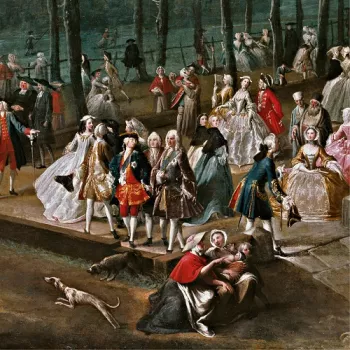
The most important series of works from the Italian Renaissance are Mantegna’s Triumphs of Caesar at Hampton Court and the Raphael Tapestry Cartoons on loan to the Victoria and Albert Museum. The Collection also holds beautiful examples of the work of Bellini, Titian, Correggio, Parmigianino and Lorenzo Lotto. There is a particularly rich group of 18th-century Italian paintings, including 50 works by Canaletto. There are outstanding examples of Flemish 17th-century painting by Rubens, Van Dyck and Teniers. There is also a fine group of works by painters associated with the Golden Age in 17th-century Holland including Jan Vermeer's A lady at the virginals with a gentleman and enriched by genre subjects by de Hooch, ter Borch, Dou, Metsu, Ostade, together with landscapes by Ruisdael and Hobbema.
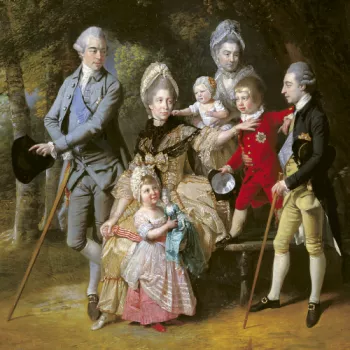
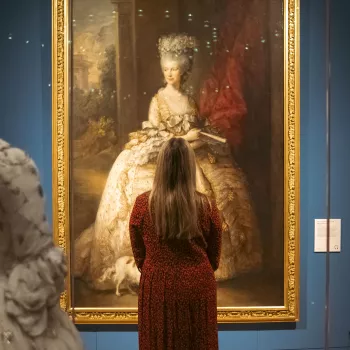
The Royal Collection provides an unparalleled history of portrait painting in Britain, from Hans Holbein in the 16th century to Lucian Freud in our own time. Every major contributor to this great tradition – Van Dyck, Lely, Hogarth, Ramsay, Reynolds, Gainsborough and Lawrence – is represented by some of their most ambitious works. The Collection embraces many types of portraiture, from the grandest images of monarchy to Johann Zoffany’s informal ‘conversation pieces’.
Portrait painting of the Victorian age is dominated by Winterhalter and Von Angeli. Queen Victoria herself particularly admired the animal painting of Landseer. Landscapes, battle-pieces, ceremonial paintings and genre scenes record the places, events and the daily life of the British Empire in its hey-day.
History
Henry VIII employed the great German portrait painter, Hans Holbein the Younger, and Charles I attracted a range of artists to England, none more important that Van Dyck. Charles I also bought en masse the collection of the Gonzaga family, the Dukes of Mantua. When the painter Rubens visited England in 1629 he was amazed to discover a collection which could bear comparison with those in the courts of Italy, France and Spain. The king’s collection was sold during Cromwell’s Protectorate (1649-59) and only re-acquired piece-meal and in part after the Restoration.
During the 18th century Frederick, Prince of Wales and his son George III proved discerning patrons and collectors, the latter acquiring at a stroke the entire collection of the English Consul in Venice and Canaletto’s agent – Joseph Smith.
George IV added abundantly tothe collection of Dutch masters almost from scratch, but also did a great deal to encourage British art. He bought the works of recently deceased painters, including Reynolds and Gainsborough, and commissioned living artists, like the Scottish genre painter, Sir David Wilkie.
Prince Albert’s interest in ‘early’ Italian, German and Netherlandish masters of the 14th and 15th centuries, who had previously been considered ‘primitive’, was profoundly influential on taste. With the acquisition of the Öttingen Wallerstein collection, Queen Victoria and Prince Albert added works by Fra Angelico, Gozzoli, Duccio and Daddi to the Collection. After the Prince’s death, 22 of the best pictures were given by the queen to the National Gallery in his memory. Prince Albert and Queen Victoria also encouraged living artists, particularly English and German, and commissioned an astonishing range of portraits, ceremonial paintings and scenes of everyday life.
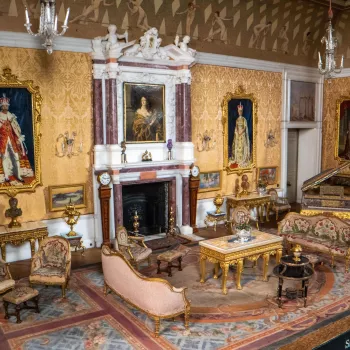
The paintings in the Royal Collection are extremely well documented. There are inventories that date back to the 16th and 17th centuries describing the works and their distribution room by room in the various residences. The display in more recent years is recorded with great accuracy by watercolours, prints and photographs. The most elaborate illustrated description is The History of the Royal Residences by William Henry Pyne, published in three volumes in 1819. Such images provide an invaluable insight into the decorative schemes of the past.
Miniatures
The 3,000 miniatures in the Royal Collection constitute one of the largest groups of such works in existence. The collection spans four centuries and includes examples by the greatest practitioners – François Clouet, Hans Holbein the Younger, Nicholas Hilliard, Isaac Oliver, Samuel Cooper, Jeremiah Meyer, Richard Cosway and Sir William Ross. The development of the miniature as an art form, from its origins in the early 16th century to its slow decline in the 19th, can be traced through examples in the Royal Collection.
History
Miniaturists held official positions at court, and during the earlier centuries their work often directly reflected the circumstances, interests and even the character of the sovereign. At the time of the Civil War (1642-9) and its aftermath leading up to the Restoration (1660) and the Glorious Revolution (1688), the livelihoods of such artists as John Hoskins, Samuel Cooper, Alexander Cooper, Richard Gibson, David des Granges, Nathaniel Thach, Thomas Flatman and Nicholas Dixon were undoubtedly affected by shifting political alliances and religious affiliations.
The Tudors were the first collectors of miniatures. Henry VIII owned examples by Lucas Hornebolte and Hans Holbein the Younger. Charles I had some 80 miniatures in the Cabinet Room in the Privy Gallery at Whitehall Palace. Following the dispersal of this collection, less than half were reacquired by or returned to his son, Charles II, after the Restoration. The Hanoverians George I and George II appointed able miniaturists, such as Lens, Boit and Christian Frederick Zincke, and the reign of George III witnessed a resurgence of the miniaturist’s art at court through artists such as Meyer, Smart and Cosway. The Prince of Wales, the future George IV, commissioned and acquired numerous works from miniaturists and enamellists, most famously from Richard Cosway.
During Queen Victoria’s reign the patronage of miniaturists continued, and artists such as Sir William Ross and Robert Thuburn were prominent. By now the miniature as an art form was beginning to give way before the development of photography. Queen Victoria’s interest in miniatures was nurtured by her passion for family and dynastic history. Her consort, Prince Albert, designed a special cabinet with sliding drawers for the storage of the collection, which was at the same time given new frames of a uniform pattern.
During the present reign The Queen has purchased miniatures of considerable significance, including a portrait of the architect Hugh May by Samuel Cooper and a portrait of Queen Henrietta Maria by John Hoskins, once in the collection of Charles I.
Information and access
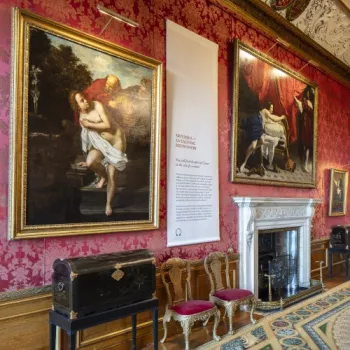
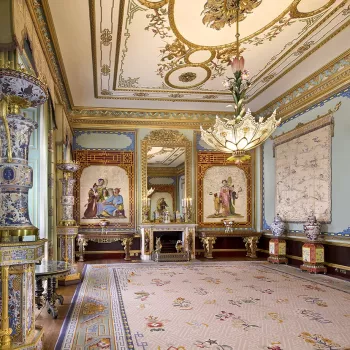
Paintings are on display throughout the royal residences and palaces. Some of the most important works are shown at Windsor Castle, Buckingham Palace and Hampton Court Palace.
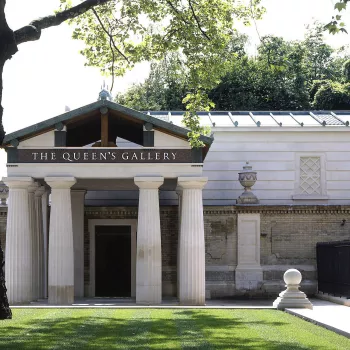
Outstanding paintings and miniatures from all periods are regularly included in special exhibitions at the royal residences, particularly at The Queen’s Galleries in London and Edinburgh, and can be seen on the Royal Collection’s e-Gallery. Catalogues and publications relating to these exhibitions are available through the Royal Collection’s online shop. Pictures are also loaned to exhibitions organised by other institutions.
Enquiries may be sent by post, fax or e-mail to:
The Surveyor of The Queen’s Pictures York House St James's Palace London SW1A 1AA Fax +44 (0)20 7839 8168 E-mail pictures@royalcollection.org.uk Bibliography
Paintings
Lorne Campbell, The Early Flemish Pictures in the Collection of Her Majesty The Queen, Cambridge, 1985 John Cornforth, Queen Elizabeth, The Queen Mother at Clarence House, London, 1996 Michael Levey, The Later Italian Pictures in the Collection of Her Majesty The Queen, 2nd edn, Cambridge, 1991 Christopher Lloyd, The Queen’s Pictures, Royal Collectors through the Centuries, London, 1991 Christopher Lloyd, The Royal Collection. A Thematic Exploration, 3rd edn., London, 2003 Oliver Millar, The Queen’s Pictures, London, 1977 Oliver Millar, The Tudor, Stuart and Early Georgian Pictures in the Collection of Her Majesty The Queen, 2 vols, London, 1963 Oliver Millar, The Later Georgian Pictures in the Collection of Her Majesty The Queen, 2 vols., London, 1969 Oliver Millar, The Victorian Pictures in the Collection of Her Majesty The Queen, 2 vols., Cambridge, 1992 William Pyne, The History of the Royal Residences of Windsor Castle, St James’s Palace, Carlton House, Kensington Palace, Hampton Court, Buckingham House, and Frogmore, 3 vols., London, 1819 Graham Reynolds, The Sixteenth- and Seventeenth-century Miniatures in the Collection of Her Majesty The Queen, London, 1999 J. Roberts (ed.), Royal Treasures: a Golden Jubilee Celebration, London, 2002 J. Roberts (ed.), George III & Queen Charlotte. Patronage, Collecting and Court Taste, London, 2004 John Sherman, The Early Italian Pictures in the Collection of Her Majesty The Queen, Cambridge, 1983 Richard Walker, The Eighteenth and Early Nineteenth-century Miniatures in the Collection of Her Majesty The Queen, Cambridge, 1992 Christopher White, The Dutch Pictures in the Collection of Her Majesty The Queen, Cambridge, 1982 Christopher White, The Later Flemish Pictures in the Collection of Her Majesty The Queen, London, 2007
Miniatures
Christopher Lloyd and Vanessa Remington, Masterpieces in Little. Portrait Miniatures from the Collection of Her Majesty Queen Elizabeth II, London 1996 Graham Reynolds, The Sixteenth and Seventeenth-century Miniatures in the Collection of Her Majesty The Queen, London, 1999 J. Roberts (ed.), Royal Treasurers: a Golden Jubilee Celebration, London 2002 J. Roberts (ed.), George III & Queen Charlotte. Patronage, Collecting and Court Taste, London, 2004 Richard Walker, The Eighteenth and Early Nineteenth-century Miniatures in the Collection of Her Majesty The Queen, Cambridge, 1992 |
|
 Rembrandt
 Attr. to Louis Le Nain
 Claude Gellee
 Gerard ter Borch
 Gerrit Dou
 Sebastiano Ricci
 Johan Zoffany
 William Powell Frith
 Graham Sutherland
 Sir Anthony Van Dyck
 Hans Holbein
 Francois Clouet
 Jean-Etienne Liotard
|